

Website launch: get 10% off your sharpening service with code LANCEMENT10
About
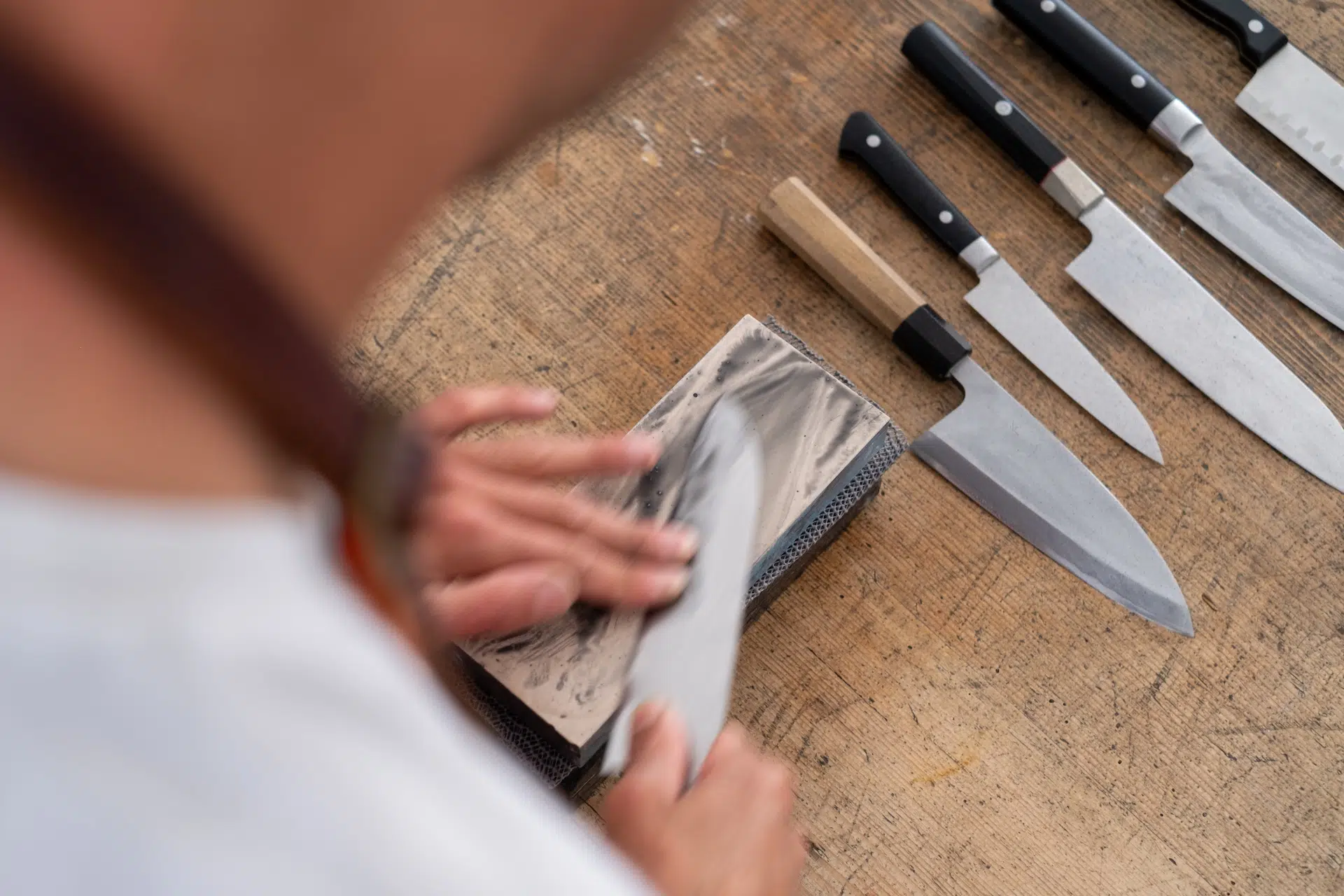
Behind every sharpened blade lies a practised motion, a set of stones, and a man who made this passion his profession.
Qui suis-je ?
My name is Jordan. I grew up in Alsace, facing the Vosges. It is the kind of place where you learn early that good tools deserve care. Knives have been a passion since my teens. Bushcraft blades, Japanese kitchen knives, vineyard pruning shears. I have always been fascinated by what a well-sharpened edge changes in the hand.
Today I am a winegrower in the Bugey and a sharpener. Both trades teach me patience and observation. Togi Toki is where those two demands meet.

About the project
Togi Toki grew out of a slightly crazy idea: to offer Japanese whetstone sharpening services directly inside restaurants. The idea took shape after I saw how poorly maintained their knives were. Traditional knife grinders do exist, of course, but sharpening on Japanese whetstones simply was not on offer.
I have been interested in knives since I was a teenager, back when I was looking for the perfect blades for bushcraft, trekking and travel. I already owned very effective models, such as Esee knives, well known for expeditions and military use.
That passion for knives stayed with me until it became intertwined with my love of cooking. That is when I discovered Japanese knives, my first purchase being a Miyabi Gyuto in VG10 33-layer Damascus steel. It was a revelation.
I realised there was something special about these blades, far beyond their beauty. I was holding a knife that was useful, durable and remarkably effective, both in how it cut and in its geometry and balance.
Throughout those years, alongside my work as a winegrower, I tried to sharpen my own knives and pruning shears with very average results. It was only when I acquired my first asymmetric knives and my first Japanese carbon steel pruning shears that I really had to dive into this craft.
I have been interested in knives since I was a teenager, back when I was looking for the perfect blades for bushcraft, trekking and travel. I already owned very effective models, such as Esee knives, well known for expeditions and military use.
That passion for knives stayed with me until it became intertwined with my love of cooking. That is when I discovered Japanese knives, my first purchase being a Miyabi Gyuto in VG10 33-layer Damascus steel. It was a revelation.
I realised there was something special about these blades, far beyond their beauty. I was holding a knife that was useful, durable and remarkably effective, both in how it cut and in its geometry and balance.
Throughout those years, alongside my work as a winegrower, I tried to sharpen my own knives and pruning shears with very average results. It was only when I acquired my first asymmetric knives and my first Japanese carbon steel pruning shears that I really had to dive into this craft.
One evening, in a lovely restaurant, the idea came up during a conversation with Chloé. After I told her that the artisanal knives there had gone dull, she said this was exactly what I should be doing: offering chefs a Japanese whetstone sharpening service directly in their establishments.
After several months of learning (books, websites, videos), I was able to put all that knowledge into practice on my own knives. I worked intensively to reach results I was truly happy with. I set up my micro-business, drew up a business plan with Chloé’s help, and launched by offering my services to restaurants.
The challenge was a serious one. Getting a quality edge on my own knives, which had not suffered much damage, turned out to be within reach. But it was by discovering the variety of blades in these establishments that I had to keep improving, adapting my technique to each type of damage, finding the right tools, all while optimising both time and results.
Thanks to my clients’ trust, in less than a year I sharpened more than 600 knives of every size and shape, along with pruning shears, mandoline blades and slicer blades, all on water stones.
After several months of learning (books, websites, videos), I was able to put all that knowledge into practice on my own knives. I worked intensively to reach results I was truly happy with. I set up my micro-business, drew up a business plan with Chloé’s help, and launched by offering my services to restaurants.
The challenge was a serious one. Getting a quality edge on my own knives, which had not suffered much damage, turned out to be within reach. But it was by discovering the variety of blades in these establishments that I had to keep improving, adapting my technique to each type of damage, finding the right tools, all while optimising both time and results.
Thanks to my clients’ trust, in less than a year I sharpened more than 600 knives of every size and shape, along with pruning shears, mandoline blades and slicer blades, all on water stones.
Why Japanese stones?
I chose to work with water stones, and that choice has several advantages over traditional grinding wheels. Those wheels come with real drawbacks. They heat the blade, which risks drawing the temper from the steel. They can deform it. They wear it down faster and give less control over the sharpening. Quality wet wheels with slow rotation do exist, but they are expensive, bulky and rare.
I have also seen recurring problems with traditional regrinding. First, a poor grasp of knife geometry, whether Western or Japanese, often visible in deformed blades (accentuated tips, a “belly” formed in the middle of the knife). Second, edges ground back far more than needed, which removes a lot of steel and shortens the knife’s life. Third, a sharpening speed that is far too high, leaving no room to observe the blade, understand it and adapt the technique.
I use Japanese stones specifically for the range and precision of their grits. They come from a sharpening tradition, that of the togishi, built around the steels used in Japanese knives. That range of grits, from coarse shaping through to finishing, allows fine control at every stage, and it comes from makers whose craft has been recognised for decades.
I have also seen recurring problems with traditional regrinding. First, a poor grasp of knife geometry, whether Western or Japanese, often visible in deformed blades (accentuated tips, a “belly” formed in the middle of the knife). Second, edges ground back far more than needed, which removes a lot of steel and shortens the knife’s life. Third, a sharpening speed that is far too high, leaving no room to observe the blade, understand it and adapt the technique.
I use Japanese stones specifically for the range and precision of their grits. They come from a sharpening tradition, that of the togishi, built around the steels used in Japanese knives. That range of grits, from coarse shaping through to finishing, allows fine control at every stage, and it comes from makers whose craft has been recognised for decades.
Why natural stones?
I use both synthetic and natural stones, each with its strengths depending on the stage of sharpening. Natural stones, the ones used by the Japanese togishi, the masters who sharpen and polish knives and katanas, interest me especially as a complement to my work. I turn to them for the finish of every knife.
These stones have many strengths. Often large and stable, they give a livelier feel and clearer tactile feedback, and they allow very refined finishes, with an edge whose micro-teeth are slightly irregular. That produces a slightly more responsive bite than uniform-grit synthetic stones, and better edge retention over time. The slurry they create, essential to sharpening, is very fine. How fast it forms varies from stone to stone, and some softer ones build it very quickly.
These stones have many strengths. Often large and stable, they give a livelier feel and clearer tactile feedback, and they allow very refined finishes, with an edge whose micro-teeth are slightly irregular. That produces a slightly more responsive bite than uniform-grit synthetic stones, and better edge retention over time. The slurry they create, essential to sharpening, is very fine. How fast it forms varies from stone to stone, and some softer ones build it very quickly.
At roughly equivalent grit (natural stones, also called JNAT, have no exact grit rating, and even two synthetic stones of the same grit from different makers give different results), natural stones tend to give a different edge, more toothy, one that favours retention over time rather than a perfectly smooth wire. There is no doubt that synthetic stones give very good results.
It is mainly a matter of preference and purpose. For my part, I have chosen natural stones as a complement, and always for my finishes. I have gathered several of these stones over the years, including my latest, which I will present in detail in a dedicated article. These ORS are of excellent quality and produce exceptional finishes. That is what I want for my clients.
It is mainly a matter of preference and purpose. For my part, I have chosen natural stones as a complement, and always for my finishes. I have gathered several of these stones over the years, including my latest, which I will present in detail in a dedicated article. These ORS are of excellent quality and produce exceptional finishes. That is what I want for my clients.